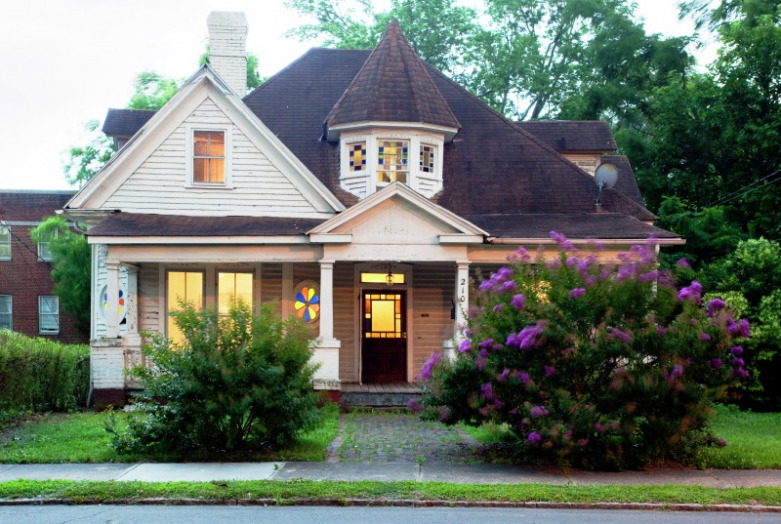
Applications are up across the state this year in terms of the number of owners of non-income producing historic properties submitting proposals for tax credits, according to Mitch Wilds of the state Historic Preservation Office. Wilds spoke on the “Tax Benefits of Residential Rehabilitation” during Preservation North Carolina’s Annual Conference Oct. 29-31 in New Bern.
“Tax credits provide a dollar-for-dollar reduction in the amount of taxes owed with up to 30 percent tax credits available through the state for private homes or condominiums that are certified rehabilitation projects,” Wilds said. Although federal funds are not available for non-income producing properties, historic preservationists are hoping to see a federal equivalency approved in the near future.
To qualify for the state credit, private properties must be on the National Register of Historic Places or a contributing structure in a national historic district. All rehabilitation work must meet the Secretary of the Interior’s Standards for Rehabilitation.
The owner should begin taking the tax credit in the year the project is completed, he said. State tax credits may be taken in five equivalent installments. Any unused portion may be carried forward five years.
There is initially a two-step application process. In Part A of the process, the applicant should submit a description of the work before embarking upon the project to “resolve potential design and rehabilitation problems that could result in denial of the credits,” Wilds explained. The state Historic Preservation Office likes to see site plans, floor plans, possible elevation drawings and other renderings of the existing site, as well as a detailed of the proposed work. For part A of the application, there is a $250 application fee.
In Part B, the state will request certification for the completed work to determine if the final project has conformed to the standards for rehabilitation. Hard-copy photographs (no CD’s or emails) should be submitted showing both exterior and interior views of the building. Additional application fees must be submitted along with Part B of the application. There is a fee chart included with the paperwork that shows the amount required and is based upon the amount of the project. This fee can cost up to $1,000 for a $100,000 to $150,000 project, but can be included as one of the soft costs in your project.
If the homeowner decides to sell the property, the tax credits are fully transferable to the new owner.
Here are the guidelines that Mitch Wilds distributed from the North Carolina Historic Preservation Office:
State and Federal Historic Rehabilitation Tax Credits
* State tax credits are available for the rehabilitation of non-income-producing historic properties in addition to federal and state tax credits for income-producing historic properties. The present historic preservation tax credit measures provide:
* A 20% state tax credit for rehabilitation of income-producing historic tax structures that also qualify for the 20% federal investment tax credit. In effect, the combined federal-state credits reduce the cost of a certified rehabilitation of an income-producing historic structure by 40%.
* A 30% state tax credit for qualifying rehabilitation of non-income-producing historic structures, including owner-occupied personal residences. There is no equivalent federal credit for rehabilitations.
Non-income-producing properties
* Property owners of historic structures are strongly advised to consult with the State Historic Preservation Office before beginning a rehabilitation to resolve potential design and rehabilitation problems that could result in denial of the credits.
* Only certified historic structures will qualify for the credits. A “certified historic structure” is defined as a building that is listed in the National Register of Historic Places, either individually or as a contributing building in the National Register historic district, or as a contributing building within a local historic district that has been certified by the U.S. Department of the Interior. (There are only three of the latter in North Carolina. These are the Blount Street Historic District in Raleigh, the Goldsboro Historic District, and the Decatur-Hunter Historic District in Madison).
* A non-income-producing building must be a “certified historic structure” at a time the state credit is taken – that is, it must be actually listed in the National Register of Historic Places or it will not qualify for the state credit. Property owners must begin taking the credit in the year the rehabilitation project is completed.
* An owner may begin a rehabilitation project on a non-income-producing property prior to listing the property in the National Register, with the intention of having it listed in the Register by the time the project is completed. However, because listing of a property by a desired deadline cannot be guaranteed, owners are strongly urged to secure National Register listing of their non-income-producing property prior to beginning a certified rehabilitation.
* The rehabilitation of the historic structure must be substantial. For non-income-producing properties, the rehabilitation expenses must exceed $25,000 within a 24-month period, sometime during the project.
* The State Historic Preservation Office reviews rehabilitation work on non-income-producing historic structures. All rehab work must meet the Secretary of the Interior’s “Standards of Rehabilitation.”
* The credits cannot be claimed against the cost of acquisition, enlargement of an existing building (additions), site work, or personal property. Only costs incurred in work upon or within a historic structure will qualify.
“A property is listed in the National Register of Historic Places by a nomination, which is a research report prepared according to detailed state and federal guidelines. The final authority on the National Register listing is the federal Keeper of the National Register in Washington, DC. In its role as administrator of the National Register program in North Carolina, the NC State Historic Preservation is charged with ensuring that nominations forwarded by the State Historic Preservation Officer to the Keeper are complete and correct. The State Historic Preservation Office provides direction to preparers but does not write nominations. Most nominations are prepared by private consultants hired by property owners, local governments, or private non-profit organizations. The nomination process may take six months to two years or longer.”
“Tax credits provide a dollar-for-dollar reduction in the amount of taxes owed with up to 30 percent tax credits available through the state for private homes or condominiums that are certified rehabilitation projects,” Wilds said. Although federal funds are not available for non-income producing properties, historic preservationists are hoping to see a federal equivalency approved in the near future.
To qualify for the state credit, private properties must be on the National Register of Historic Places or a contributing structure in a national historic district. All rehabilitation work must meet the Secretary of the Interior’s Standards for Rehabilitation.
The owner should begin taking the tax credit in the year the project is completed, he said. State tax credits may be taken in five equivalent installments. Any unused portion may be carried forward five years.
There is initially a two-step application process. In Part A of the process, the applicant should submit a description of the work before embarking upon the project to “resolve potential design and rehabilitation problems that could result in denial of the credits,” Wilds explained. The state Historic Preservation Office likes to see site plans, floor plans, possible elevation drawings and other renderings of the existing site, as well as a detailed of the proposed work. For part A of the application, there is a $250 application fee.
In Part B, the state will request certification for the completed work to determine if the final project has conformed to the standards for rehabilitation. Hard-copy photographs (no CD’s or emails) should be submitted showing both exterior and interior views of the building. Additional application fees must be submitted along with Part B of the application. There is a fee chart included with the paperwork that shows the amount required and is based upon the amount of the project. This fee can cost up to $1,000 for a $100,000 to $150,000 project, but can be included as one of the soft costs in your project.
If the homeowner decides to sell the property, the tax credits are fully transferable to the new owner.
Here are the guidelines that Mitch Wilds distributed from the North Carolina Historic Preservation Office:
State and Federal Historic Rehabilitation Tax Credits
* State tax credits are available for the rehabilitation of non-income-producing historic properties in addition to federal and state tax credits for income-producing historic properties. The present historic preservation tax credit measures provide:
* A 20% state tax credit for rehabilitation of income-producing historic tax structures that also qualify for the 20% federal investment tax credit. In effect, the combined federal-state credits reduce the cost of a certified rehabilitation of an income-producing historic structure by 40%.
* A 30% state tax credit for qualifying rehabilitation of non-income-producing historic structures, including owner-occupied personal residences. There is no equivalent federal credit for rehabilitations.
Non-income-producing properties
* Property owners of historic structures are strongly advised to consult with the State Historic Preservation Office before beginning a rehabilitation to resolve potential design and rehabilitation problems that could result in denial of the credits.
* Only certified historic structures will qualify for the credits. A “certified historic structure” is defined as a building that is listed in the National Register of Historic Places, either individually or as a contributing building in the National Register historic district, or as a contributing building within a local historic district that has been certified by the U.S. Department of the Interior. (There are only three of the latter in North Carolina. These are the Blount Street Historic District in Raleigh, the Goldsboro Historic District, and the Decatur-Hunter Historic District in Madison).
* A non-income-producing building must be a “certified historic structure” at a time the state credit is taken – that is, it must be actually listed in the National Register of Historic Places or it will not qualify for the state credit. Property owners must begin taking the credit in the year the rehabilitation project is completed.
* An owner may begin a rehabilitation project on a non-income-producing property prior to listing the property in the National Register, with the intention of having it listed in the Register by the time the project is completed. However, because listing of a property by a desired deadline cannot be guaranteed, owners are strongly urged to secure National Register listing of their non-income-producing property prior to beginning a certified rehabilitation.
* The rehabilitation of the historic structure must be substantial. For non-income-producing properties, the rehabilitation expenses must exceed $25,000 within a 24-month period, sometime during the project.
* The State Historic Preservation Office reviews rehabilitation work on non-income-producing historic structures. All rehab work must meet the Secretary of the Interior’s “Standards of Rehabilitation.”
* The credits cannot be claimed against the cost of acquisition, enlargement of an existing building (additions), site work, or personal property. Only costs incurred in work upon or within a historic structure will qualify.
“A property is listed in the National Register of Historic Places by a nomination, which is a research report prepared according to detailed state and federal guidelines. The final authority on the National Register listing is the federal Keeper of the National Register in Washington, DC. In its role as administrator of the National Register program in North Carolina, the NC State Historic Preservation is charged with ensuring that nominations forwarded by the State Historic Preservation Officer to the Keeper are complete and correct. The State Historic Preservation Office provides direction to preparers but does not write nominations. Most nominations are prepared by private consultants hired by property owners, local governments, or private non-profit organizations. The nomination process may take six months to two years or longer.”
For more information on historic preservation certifications, contact:
David Christenbury
David Christenbury
Preservation Architect/Tax Credit Coordinator Restoration Branch
N.C. State Historic Preservation Office NC Division of Historical Resources
4617 Mail Service Center
Raleigh NC 27699-4617
Telephone: 919-807-6574
Fax: 919-807-6599
email: david.christenbury@ncdcr.gov
For more information about the National Register of Historic Places and the requirements and procedures of listing, contact:
Ann Swallow, National Register Coordinator
Survey and Planning Branch
NC State Historic Preservation Office
NC Division of Historical Resources
4617 Mail Service Center
Raleigh NC 27699-4617
Telephone: 919-807-6587
Fax: 919-807-6599
ann.swallow@ncmail.net
State Historic Preservation Office, Office of Archives and History, Division of Historical Resources, North Carolina Department of Cultural Resources
http://www.hpo.ncdcr.gov/